
Flies
Drain Flies
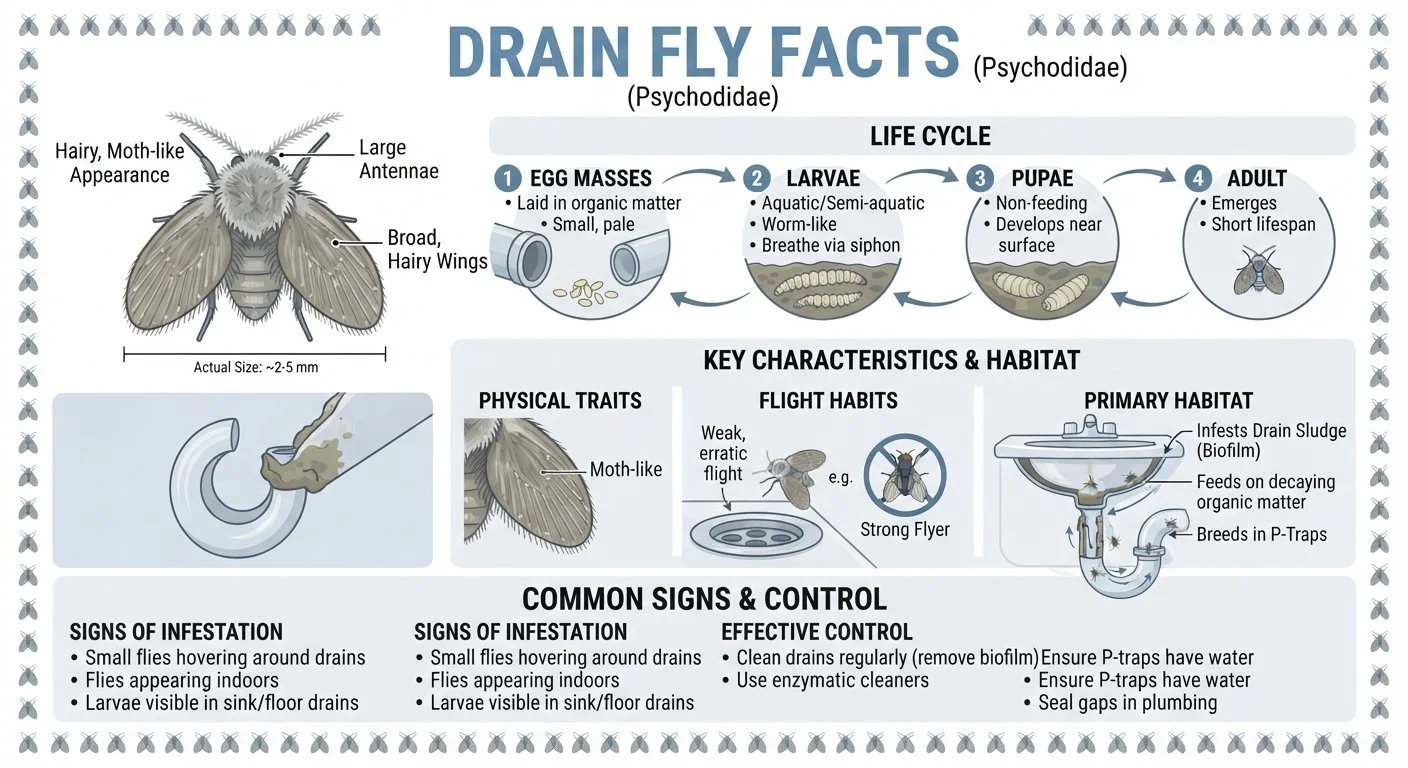
Drain flies (family Psychodidae), also known as moth flies or sewer flies, are small, fuzzy insects commonly found near plumbing. Here are the essential facts about them:
Appearance: Adults are tiny (2–5 mm) and distinctively "hairy" or "fuzzy," giving them the appearance of a tiny moth. Their wings are broad in proportion to their body and are held roof-like over the abdomen when at rest.
Flight: They are weak fliers. If disturbed, they typically make short, erratic, hopping flights rather than sustained flight.
Habitat & Food Source: The larvae and eggs are not found in the water itself, but rather in the thick, gelatinous biofilm (sludge) that accumulates inside drain pipes, P-traps, and overflow devices. They feed on this decaying organic matter, bacteria, and fungi.
Life Cycle: The complete life cycle—from egg to adult—is relatively short, typically completed in one to three weeks, depending on the temperature. This rapid reproduction can lead to large numbers quickly if the breeding source is not addressed.
Signs of Infestation and Control
Signs: The most common sign is the presence of the adult flies hovering around sinks, bathtubs, floor drains, or in shower stalls. You may also see them on walls or ceilings nearby.
Control: Killing the adult flies with a swatter or spray will not eliminate the infestation. Control requires physically eliminating the breeding ground:
Clean the Drain: Use a stiff pipe brush to scrub the inside of the drain opening and the visible portions of the pipe to remove the biofilm.
Use Cleaners: While hot water and soap help, specialized enzymatic drain cleaners or bioremediation products are often required to break down the organic sludge where the larvae live.
Maintain P-Traps: Ensure all drains have P-traps that contain water, which acts as a barrier to prevent flies from entering the living space from the sewer system.
Fruit Flies
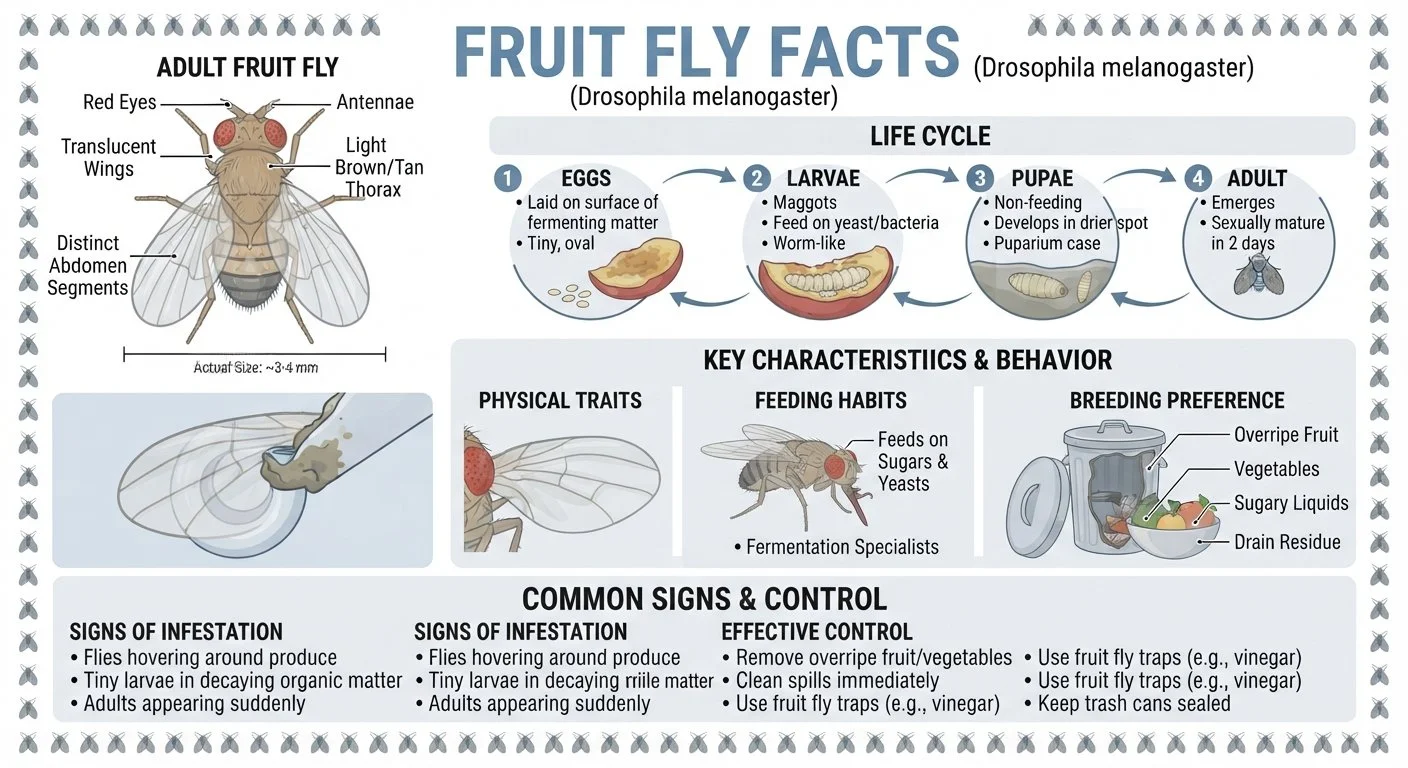
Adult Fruit Fly: A detailed diagram highlights key physical traits, including its characteristic red eyes, translucent wings, and light brown thorax. Adults are tiny, measuring only 3–4 mm.
Life Cycle: The infographic breaks down the complete metamorphosis into four stages, noting that the entire cycle can be very rapid:
Eggs: Laid on the surface of fermenting matter.
Larvae: Commonly known as maggots, they feed on yeast and bacteria within the decaying material.
Pupae: A non-feeding stage where the larva transforms inside a puparium case.
Adult: Emerges and is sexually mature in just two days.
Key Characteristics & Behavior: This section explains why fruit flies are common pests:
Feeding Habits: They are "fermentation specialists," feeding on sugars and yeasts found in rotting food.
Breeding Preference: Their primary attractants are overripe fruit, vegetables, sugary liquids, and residue found in drains.
Common Signs & Control: The final section offers practical advice for identifying and managing infestations:
Signs: Observing flies hovering around produce or finding tiny larvae in decaying matter.
Control: The most effective methods involve sanitation, such as removing overripe food, cleaning spills immediately, sealing trash cans, and using traps (e.g., vinegar).
Fungus Gnat
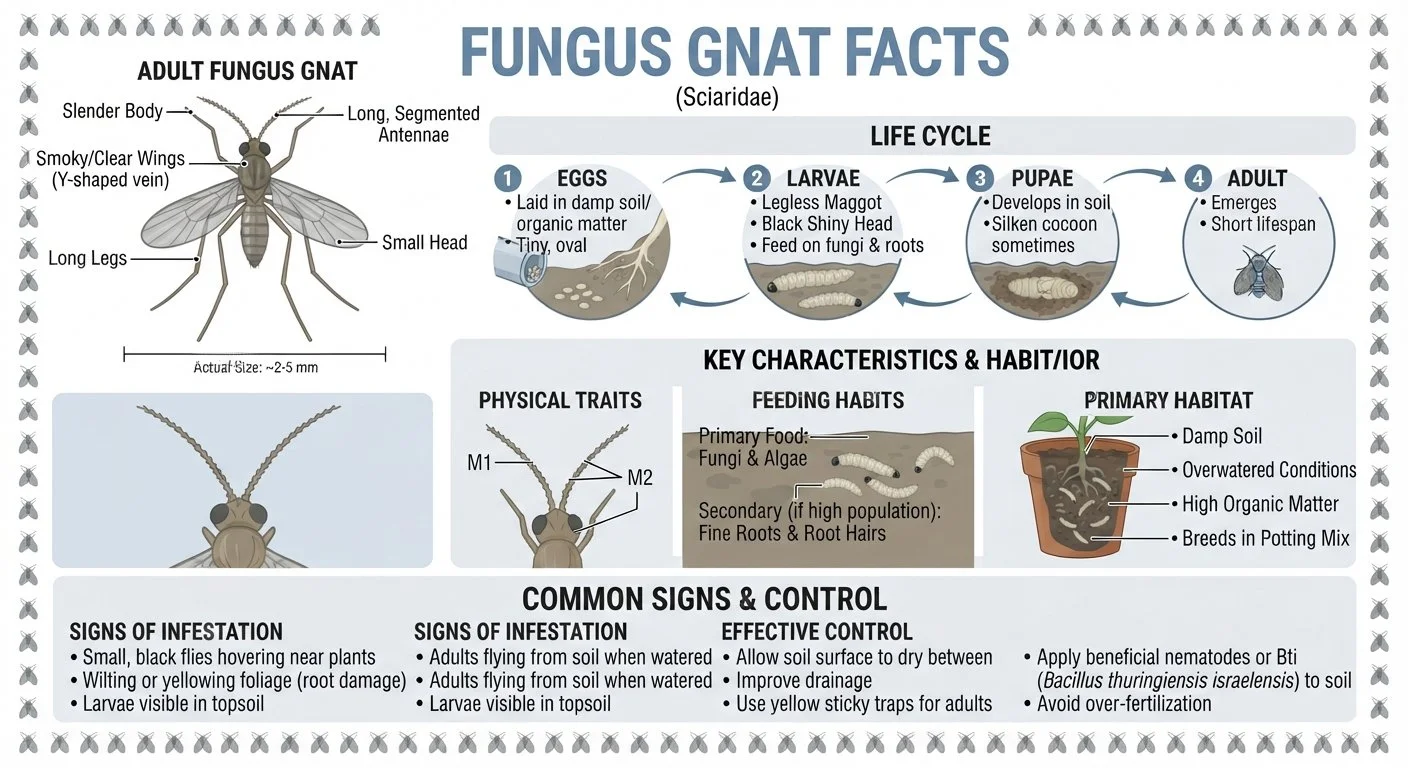
Appearance: Small, delicate flies that are black or dark gray.
Size: Very small, typically measuring 2–5 mm in length.
Key Features: They have long, segmented antennae, long legs, and characteristic smoky or clear wings with a distinct "Y-shaped" vein (M1 and M2).
Life Cycle
The complete life cycle takes approximately 3–4 weeks and occurs entirely within the soil/organic matter:
Eggs: Tiny, oval eggs are laid in damp, organic-rich soil.
Larvae: Legless, worm-like maggots with shiny black heads. They live in the soil and feed primarily on fungi, algae, and organic matter.
Pupae: Larvae pupate within the soil, sometimes creating a delicate silken cocoon.
Adult: The adult gnat emerges from the pupa. Adults have a short lifespan, focusing on mating and laying eggs.
Habitat and Feeding Habits
Primary Habitat: Fungus gnats thrive in damp, overwatered soil with high organic matter, making potted plants an ideal breeding ground.
Food Source (Larvae): Their main diet is fungi and algae.
Root Damage: While they prefer fungi, the larvae will feed on fine root hairs and roots when the gnat population is high, causing damage to plants.
Infestation and Control
Signs of Infestation:
Small, black flies hovering around houseplants or soil.
Adults flying up from the soil when the plant is watered.
Larvae visible in the topsoil.
Wilting, yellowing foliage, or poor plant growth (indicating root damage).
Effective Control Methods:
Cultural: Allow the soil surface to dry out between waterings (this kills larvae and discourages egg-laying) and improve drainage.
Physical: Use yellow sticky traps to capture adult flies.
Biological: Apply beneficial nematodes or Bacillus thuringiensis israelensis (Bti) to the soil to target larvae.
Preventative: Avoid over-fertilization, which can promote fungal growth.
Filth Flies
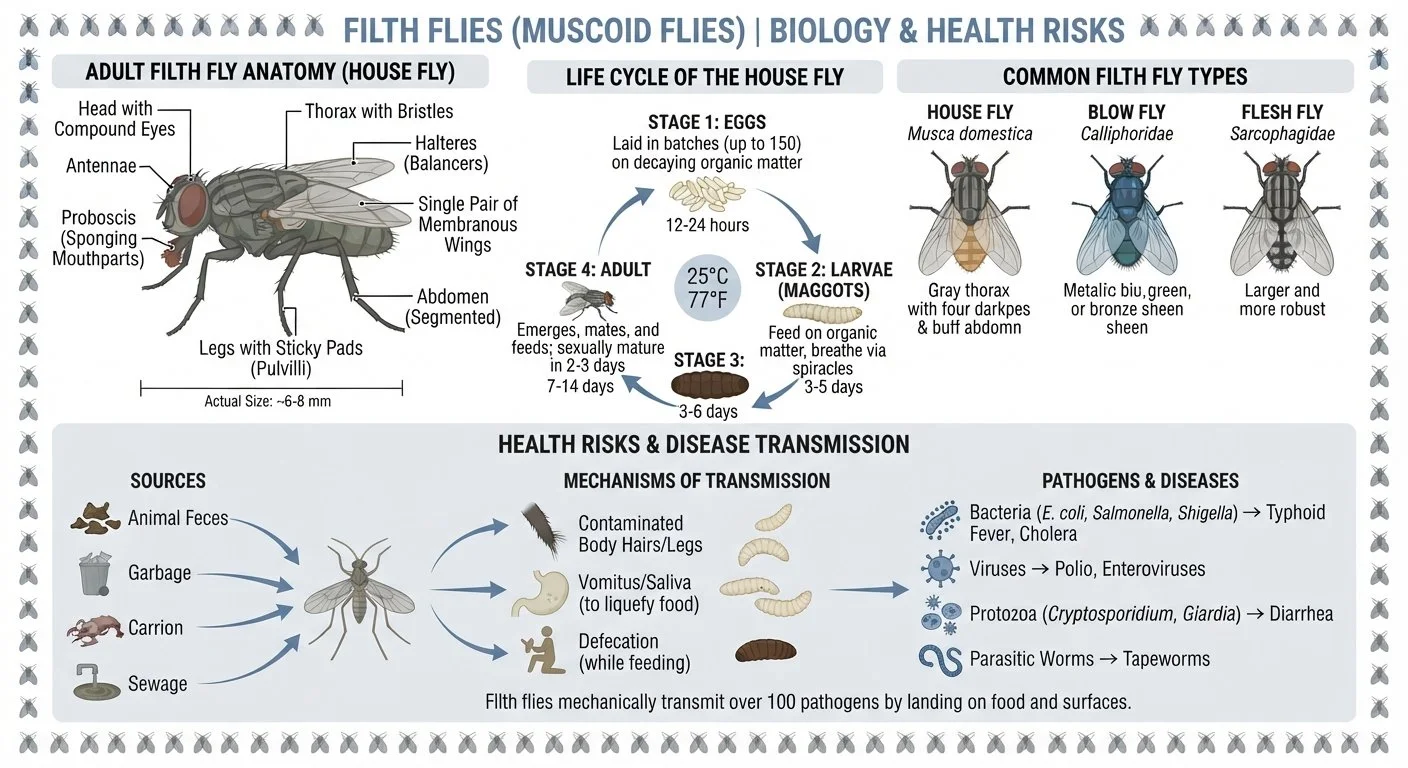
The term "filth fly" encompasses several species. The most common examples are:
House Fly (Musca domestica): Identified by a gray thorax with four dark stripes and a buff-colored abdomen.
Blow Fly (Calliphoridae): Known for a brilliant, metallic blue, green, or bronze sheen.
Flesh Fly (Sarcophagidae): Larger and more robust than a house fly, with a gray thorax (three dark stripes) and a checkerboard pattern on the abdomen.
2. Adult Anatomy
While species vary in color, their structure is similar. Key features of the house fly include:
Size: Small, typically 6–8 mm.
Mouthparts: A specialized proboscis used for sponging up liquids. (Flies must liquefy solid food by vomiting on it before they can eat).
Mobility: They have a single pair of membranous wings and specialized balancing organs called halteres. Their legs have sticky pads (pulvilli) that allow them to walk on virtually any surface, including walls and ceilings.
Sensory: They possess large compound eyes for excellent vision and antennae for smell.
3. Life Cycle
Filth flies undergo complete metamorphosis (egg, larva, pupa, adult), and their life cycle can be very rapid, often completed in 7–14 days under warm conditions (e.g., 25°C/77°F).
Stage 1: Eggs: Laid in batches of up to 150 on decaying organic matter. (12–24 hours).
Stage 2: Larvae (Maggots): Legless, cream-colored worms that feed directly on the organic matter where they hatched. (3–5 days).
Stage 3: Pupae: A transformation stage where the larva hardens into a dark, barrel-shaped case. This usually occurs in drier soil away from the food source. (3–6 days).
Stage 4: Adult: The fly emerges from the puparium. Adults mate, feed, and are ready to reproduce within 2–3 days.
4. Health Risks and Disease Transmission
Filth flies are major public health concerns. They act as mechanical vectors, meaning they carry pathogens on their bodies without the pathogen developing or multiplying within the fly. They are known to transmit over 100 different pathogens.
Sources of Contamination: They breed and feed on highly unsanitary materials, including animal feces, garbage, carrion, and sewage.
Mechanisms of Transmission: Pathogens are picked up from these sources and transferred to human food and surfaces via:
Contaminated body hairs and legs.
Vomitus/Saliva (used to liquefy food).
Defecation (which often occurs while the fly is feeding).
Associated Diseases: Examples of diseases transmitted include:
Bacteria: E. coli, Salmonella, Shigella (causing Typhoid Fever and Cholera).
Viruses: Polio and Enteroviruses.
Protozoa: Cryptosporidium and Giardia (causing Diarrhea).
Parasitic Worms: Tapeworms.